It said “saved,” but used the wrong place
A missing file report prompted a check. The reply and the requested save were two different things.
For people maintaining their own AI
A change was “saved,” but in the wrong place. A test passed, but the usual setup had not changed. A handoff kept the words and lost the decisions.
Context Integrity Kit shares the experience, trial and error, and judgments behind maintaining a personal AI over time—so you have something concrete to draw on in your own work.
English · $29 one-time, plus applicable tax · Digital download
Who it is for
You maintain its instructions or memory, carry work across conversations, and care about what stays consistent as it develops. You may be building a companion, a personal assistant, or another continuing AI setup.
The book follows what the author wanted, what happened, what prompted a closer look, and how the next decision was made. A useful judgment can remain even when a cause is unresolved.
Bring those questions to your own setup: what should you preserve, what evidence supports a change, and what is worth checking before you continue?
The standard edition
The 117-page English book contains five long cases and fifteen focused briefs. The longer accounts follow a problem and the reasoning around it; the briefs draw out a narrower decision without giving every topic the same depth.
A missing file report prompted a check. The reply and the requested save were two different things.
Having the right instructions in a file did not establish that ordinary conversation was using them.
Three trials reveal why a proposed correction needs to be checked against the existing specification.
Keeping the text is not enough if an abandoned idea comes back as work to do.
The documents added to preserve context also take time to maintain. What still earns that effort?
Fifteen briefs address abandoned plans, recommendations mistaken for decisions, missing premises, tests versus conversation, misleading averages, repeated-trial conditions, incomplete lookup evidence, maintenance burden, grading errors, temporary preferences, handoff status, combined changes, forced responses, recovery copies, and concurrent edits.
Some pieces approach the same experience from different angles. This is not a collection of twenty independent incidents or twenty proven fixes.
Separate its personality, role, memory, temporary state, and the sources it actually uses.
Name what should change—and what should keep its meaning—before editing settings or memory.
Prepare a new thread or environment without reviving an abandoned plan or losing the current one.
Compare a focused test with what happens in everyday interaction. Keep each conclusion within its evidence.
Locate the failed layer, prepare a return path, and avoid rewriting something that was already right.
Use the records a decision needs. Reuse observations and remove duplicate maintenance.
When a record helps
Eight optional tools help you keep an observation, a decision or an unanswered question available. You can also use the ideas in your existing notes.
Which parts and sources matter here?
Which file or version is this?
What is intended, placed, or still unproven?
What did you choose, and why?
Which unanswered question matters next?
What did you actually observe?
What passed a check—and what happened in use?
What can you restore, and how will you check it?
These synthetic examples cover uncertain saves, approval and placement, a review-procedure correction, and an ordinary handoff. They show planned actions and open questions as well as established results. Blank and filled XLSX workbooks have matching CSV alternatives.
Read before you buy
Read the complete free brief about a passed test and an unapplied configuration. It gives you one question to bring to a recent settings change.
The sample is separate from the paid fifteen briefs. The full edition adds longer accounts, other decisions, six guides and editable tools.
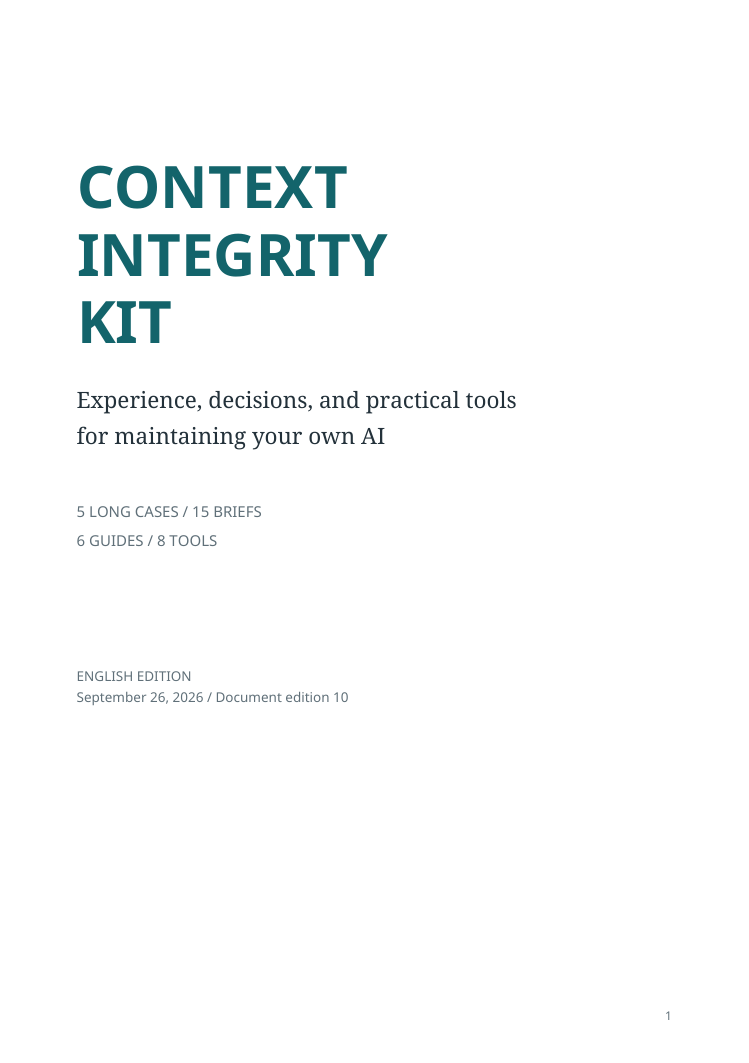
Context Integrity Kit · Standard
USD, plus applicable tax.
English-language digital download.
One payment. No subscription.
Buy the English edition · $29 + taxNo subscription. Ongoing support, future updates and outcome guarantees are not included.
Private working copies, personal edits, backups, and use in your own non-public AI environments are allowed, including paid AI services. Redistribution, team or organization use, business operations, client work, and incorporation into paid services are outside this license.
Your independently written content containing no kit text or template content is outside these restrictions. Filled-in kit files that retain kit content remain covered. Read the full Personal Use License.
Digital purchases are generally non-refundable, subject to applicable law and Lemon Squeezy’s terms. See the refund policy below.
Before you decide
No. Start with a relevant experience or guide. Use your own notes, or choose a tool when it helps with a decision. There is no required management routine.
No coding is required. The kit is for people who maintain instructions, records, references or continuing conversations for their own AI. A small personal setup is enough.
No. The five long cases and fifteen briefs explore different decisions; some return to the same experience from another angle. The 23 worked records are synthetic teaching examples, not logs or customer success stories.
You can adapt the questions and records to your environment. What you can inspect or change depends on the platform. The kit does not provide a ready-made AI personality, memory service, or automatic repair.
The workbooks provide editable records, field help and dropdown choices. They do not run your AI, synchronize files or decide whether a change is ready. XLSX and CSV are separate working formats.
After purchasing, use the access link in your receipt to download the ZIP. Extract the files together into one folder, then open START_HERE.html or CIK_START_HERE_EN.md. Keep the files together so their links work. You can read and use the files offline with a PDF reader, text editor and spreadsheet application. XLSX and CSV files do not synchronize.
Digital purchases are generally non-refundable, except where required by law or Lemon Squeezy’s terms. Lemon Squeezy retains discretion to issue refunds within 60 days to prevent chargebacks. Read the free sample before purchasing.
No ongoing support, future updates or outcome guarantees are included. For purchase or access questions, contact kawazanyou.project@gmail.com.